What is the Freedom Index?
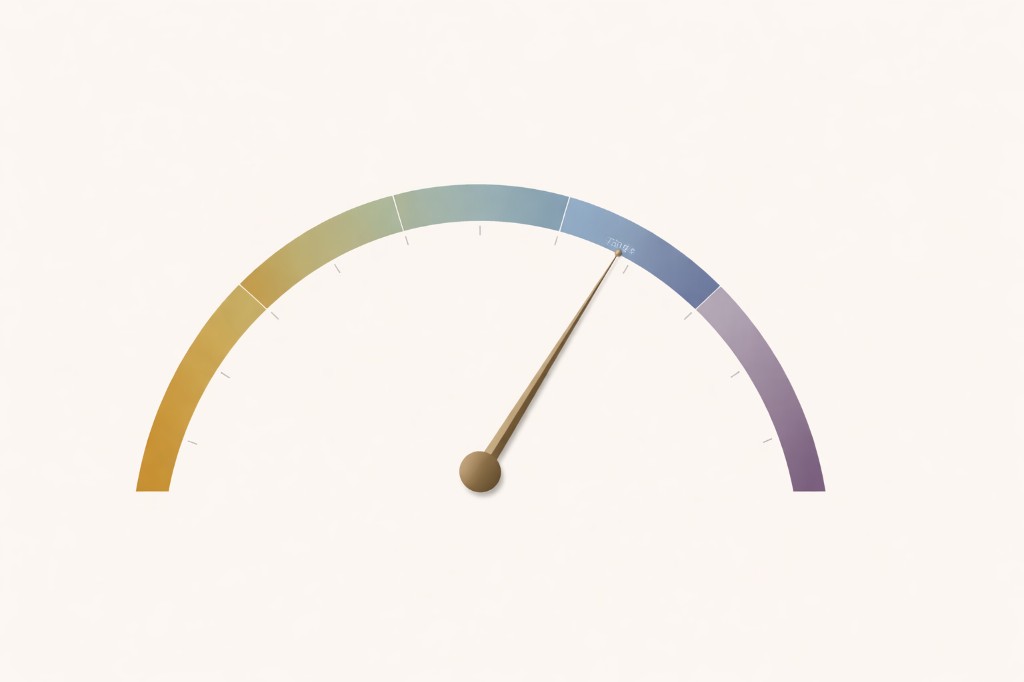
The Freedom Index is a single number from 0 to 360 that represents your structural stability across three dimensions: Health, Wealth, and Capacity. It aggregates 26 KPIs through a layered scoring system, surfacing where your life systems are stable, where they are degrading, and where failure is approaching.
Why a single number?
You already have too much data. Fitness apps give you sleep scores. Banking apps show your net worth. Calendar apps display your schedule. None of them talk to each other. None of them can tell you that your declining sleep consistency is about to cascade into financial impulsiveness, reduced cognitive capacity, and relationship friction.
The Freedom Index exists because cross-dimensional visibility requires aggregation. Individual metrics are necessary but insufficient. A single composite score forces the system to weigh trade-offs: a perfect Health score means nothing if Wealth is collapsing. The number itself is a compression of structural reality, not a simplification of it.
This is the same principle behind composite indicators in engineering and economics. A bridge does not fail because one measurement is off. It fails because multiple stressors interact. The Freedom Index applies this logic to personal infrastructure.
How does the scoring work?
The Freedom Index builds from the bottom up through four layers:
Individual indicators. Each of the 26 indicators produces its own score. Some are binary (pass/fail conditions). Others use continuous scales with thresholds. Each indicator knows what "stable" looks like for that specific metric, based on your personal baselines and targets.
Related indicators group together into 15 areas (levers). A lever is a structural component within a dimension. For example, the Health dimension includes levers for Sleep, Activity, Load, Nutrition, and Care. Each lever aggregates its indicators into a single lever score.
Areas combine into three dimension scores. Levers aggregate into three dimension scores: Health, Wealth, and Capacity. Each dimension scores 0 to 120. The dimension score reflects the structural health of that area of your life.
Dimensions combine into the Freedom Index. The three dimension scores sum to produce the Freedom Index: 0 to 360. The maximum of 360 represents structural stability across all three dimensions at full capacity. When fewer than three dimensions are active, the maximum scales proportionally: two active dimensions score 0 to 240, one to 120.
What factors affect the score?
The Freedom Index is not a simple average. Three factors modulate how KPI data translates into scores:
Recency. Recent data carries more weight than older data. A KPI that was stable three weeks ago but has been degrading for the last five days will reflect the degradation, not the historical stability. This prevents stale good data from masking current decline.
Consistency. Consistent performance scores higher than volatile performance, even if the volatile average is slightly better. A sleep consistency score of 7.2 hours with low variance outperforms alternating between 5 and 9 hours. Stability is the signal, not occasional peaks.
Trend. The direction of change matters. A score that is declining will reflect that decline before it reaches a critical threshold. This is the early warning mechanism: the Freedom Index does not wait for a dimension to collapse. It flags the trajectory.
These three factors work together to make the Freedom Index responsive to real structural changes while filtering out noise from single-day fluctuations.
What does a declining score actually mean?
A declining Freedom Index means that one or more of your life systems is losing structural stability. The score does not tell you why, because the "why" lives in the dimension and lever breakdowns. But the direction of the composite score tells you something important: the overall system is moving toward instability.
Consider how this works in practice. Your Freedom Index has been at 285 for three weeks. It drops to 271. The composite decline is small, but the decomposition reveals the source: your Health dimension dropped from 58 to 44. Within Health, the Sleep lever declined because sleep consistency KPI flagged a drift in your bedtime variance.
The Freedom Index surfaced the problem. The dimension breakdown located it. The lever and KPI detail diagnosed it. This is the diagnostic hierarchy: detect at the top, diagnose at the bottom.
Without the composite score, you would need to monitor 26 individual KPIs daily. With it, you monitor one number and drill down only when the signal warrants it.
How is this different from a wellness score?
Wellness scores, the kind you find on fitness trackers and health apps, measure how well you are doing against a set of behavioral targets. Did you hit your step goal? Did you sleep 8 hours? Did you drink enough water? These are compliance metrics. They measure effort, not structural stability.
The Freedom Index measures something different: whether the systems that compose your life are structurally sound. You can hit every wellness target and still have a declining Freedom Index, because your financial buffer is eroding, your schedule is shifting toward reactive work, or your calendar buffer has dropped below a sustainable threshold.
Wellness scores exist within one dimension. The Freedom Index spans all three. That cross-dimensional aggregation is what makes it a structural indicator rather than a behavioral one.
Free60 is the system that produces the Freedom Index. To understand the broader category of tool that Free60 represents, see What is a Life Diagnostic?
Can you manipulate the score?
You could try. You could log fabricated financial data or skip manual KPIs that are declining. But the automated KPIs, the ones pulling from HealthKit, are not under your control. Sleep data flows in passively. Activity data flows in passively. Physiological metrics flow in passively.
More importantly, gaming the score defeats the purpose. The Freedom Index is not a performance review. Nobody sees it but you. It exists to give you an honest structural reading of your life systems. Manipulating it is the equivalent of taping over a warning light on your dashboard. The underlying problem does not change.
The system is designed for people who want accurate data about what is actually happening, not flattering data about what they wish were happening. If you want the score to go up, the path is structural: fix the systems that are degrading. The score reflects reality. Change the reality, and the score follows.
You can explore the full system at free60.app.
Common questions
What's a good Freedom Index score?
There is no universal "good" score. The Freedom Index measures structural stability relative to your own baselines and targets. A score of 280 with all three dimensions balanced is structurally stronger than a score of 310 where one dimension is collapsing. The trend matters more than the absolute number. A stable 250 is better than a volatile 300.
How often does the score update?
Automated KPIs (health, activity, sleep) update daily as new HealthKit data flows in. Manual KPIs (financial, time, relational) update when you log new data. The Freedom Index recalculates whenever any underlying KPI changes, so you always see the current structural state.
Can one dimension pull down the whole score?
Yes. Each dimension contributes up to 120 points. If your Health dimension drops to 15 while the other two remain at 60, your total score is 135 instead of 180. The system is designed this way intentionally: a life that scores well in two dimensions but is collapsing in one is not structurally stable. The weak dimension constrains the whole system.
FREE60 is available now on the App Store. 14-day free trial included.
Download on the App Store