Free60 vs Habit Trackers
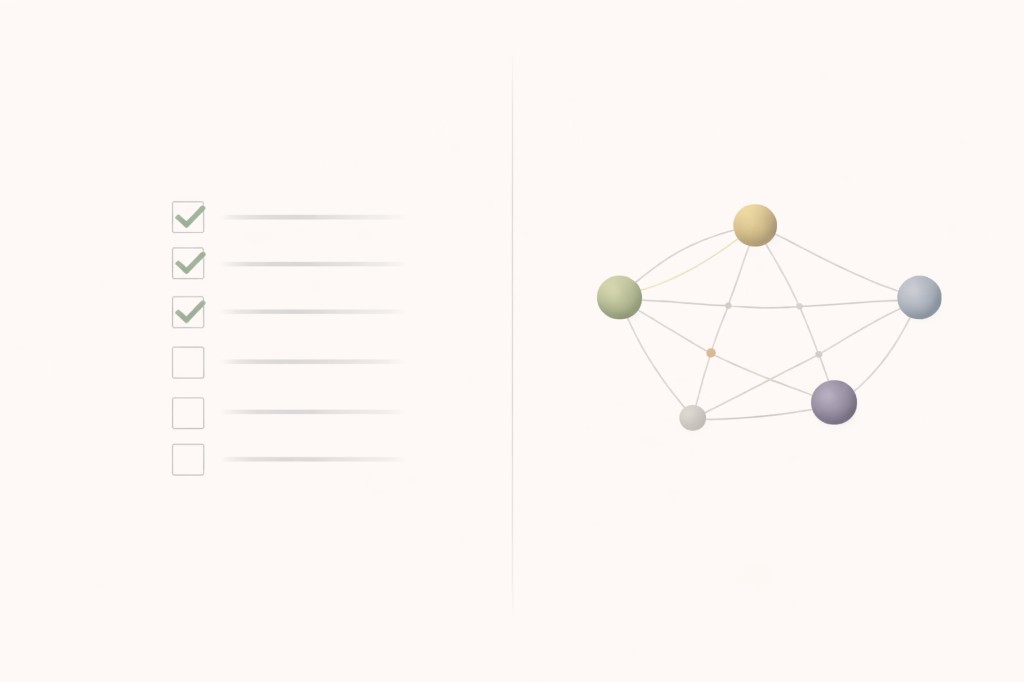
Habit trackers like Streaks, Habitica, and Loop measure daily compliance: did you do the thing you said you would do? Free60 measures structural stability across 3 dimensions, 15 levers, and 26 KPIs. It does not track habits. It detects whether your systems are holding, degrading, or approaching failure. The two categories solve fundamentally different problems.
What do habit trackers actually measure?
Habit trackers measure task completion. You define a behavior (meditate, exercise, read, drink water), set a frequency, and the app records whether you did it. The core metric is the streak: consecutive days of compliance. Some apps layer on gamification, experience points, avatars, or social accountability. The underlying assumption is consistent: if you do the right things every day, good outcomes follow.
This model works for building routines. It is a behavioral compliance tool. And it is useful when the problem is actually behavior, when you know what to do and need external reinforcement to keep doing it.
But behavior is only one input. Structure is the larger system.
What does Free60 measure instead?
Free60 measures structural stability. It tracks 26 KPIs across 3 dimensions: Health, Wealth, and Capacity. Each KPI detects a specific failure mode. Sleep Consistency detects circadian drift. Burn Stability and related expense KPIs detect spending-structure drift against income. Buffer Availability and Boundary Breach Rate detect whether protected time and slack still exist. These are not habits. They are structural indicators.
The scoring model produces a Freedom Index from 0 to 360. Each KPI contributes to a lever score, each lever contributes to a dimension score, and dimensions aggregate into the index. But the system goes beyond diagnosis. Automated insight cards explain why each failure matters, show how one degradation cascades into another, and surface specific actions based on your data. It diagnoses, educates, and guides -- without motivation, streaks, or prescriptive routines. For more on the framework, see the difference between tracking and diagnosing.
How do they score progress differently?
A habit tracker scores you on compliance. Did you complete 5 out of 5 habits today? Your score is 100%. Did you miss one? 80%. The metric is binary per task: done or not done. Streaks reward consistency of action regardless of whether that action is producing structural results.
Free60 scores you on system state. Your Sleep Consistency KPI does not care whether you set a bedtime alarm. It measures the stability of your actual sleep timing over a rolling window. Your expense-structure KPIs do not care whether you logged a single purchase. They read category-level stability and compressibility against your plan. The score reflects what is happening structurally, not what you intended to do.
This is the core distinction. Habit trackers measure intent. Free60 measures outcome at the structural level.
What happens during a bad week?
In a habit tracker, a bad week breaks your streak. You miss two days and the counter resets to zero. The app either punishes you (lost streak) or tries to recover your motivation (encouraging notifications, "don't give up" messages). Your relationship with the tool becomes adversarial during the exact period when you need clarity most.
In Free60, a bad week registers as a signal. If your sleep timing drifts, the Sleep Consistency KPI reflects the shift. If physiological strain rises against autonomic balance, Strain Trend and Autonomic Balance move. The system does not punish or encourage. It reports. A single bad week may not move your scores significantly because the rolling windows absorb short-term variance. But sustained drift accumulates, and the system flags it before it becomes a structural failure.
This difference matters for the people Free60 is built for: professionals who need diagnostics, not compliance pressure.
What do they tell you when everything looks green?
A habit tracker showing all green means you completed your habits. That is all it can tell you. It cannot tell you whether your financial structure is eroding, whether your sleep architecture is degrading beneath the surface, whether your schedule is quietly shifting toward reactive work, or whether your calendar buffer is disappearing. It only sees the behaviors you asked it to watch.
Free60 showing all green means 26 KPIs across 3 dimensions are within their healthy thresholds. That is a fundamentally different statement. It means your Health levers (sleep, load, activity, nutrition, care), Wealth levers (income, expenses, liquidity, investments, risk), and Capacity levers (priorities, focus, schedule, buffer, routine) are structurally stable at the KPI level. No single-domain tracker can make that claim because no single-domain tracker sees the full picture.
Who is each tool designed for?
Habit trackers are designed for people building new routines. Students forming study habits. People starting a fitness program. Anyone who needs daily reinforcement to establish consistency. The tool assumes the user knows what to do but struggles to do it consistently. That is a valid problem, and habit trackers solve it well.
Free60 is designed for analytical, self-directed professionals, typically 35 to 50, in senior roles. People who already have routines. People whose problem is not "I don't exercise" but "something is off and I cannot pinpoint what." These people have tried habit trackers, wearables, productivity apps, and spreadsheets. They abandoned most of them because the tools measured the wrong thing or required daily engagement that felt like overhead rather than insight.
Free60 requires minimal ongoing effort. Automated KPIs pull from HealthKit data passively. Manual KPIs require brief periodic updates. The system runs in the background and surfaces what matters. No streaks to maintain. No daily check-ins to perform.
Can a perfect streak coexist with structural failure?
Yes. This is the blind spot that habit trackers cannot address. You can maintain a perfect meditation streak while your financial reserves are depleting. You can hit your exercise target every day while your sleep architecture deteriorates because you are training at the wrong time. You can complete every daily habit while your boundary integrity erodes because the habits themselves do not detect cross-dimensional failure.
Free60 sees across dimensions. The Freedom Index aggregates signals from Health, Wealth, and Capacity into a single structural assessment. A cascade in one dimension, like declining liquidity compounding with increasing time pressure, shows up as a pattern, not as a missed habit. That is what a diagnostic system is designed to detect.
Is this a matter of choosing one over the other?
Not necessarily. A habit tracker and Free60 operate at different levels. One measures behavioral compliance. The other measures structural stability. If you are actively building a new routine, a habit tracker serves that specific function. But if you need visibility into whether your overall system is stable, whether the structure beneath your routines is holding, a habit tracker cannot provide that. It was never designed to.
The question is not which tool is better. The question is which problem you are trying to solve. If the answer is "I need to build consistency," use a habit tracker. If the answer is "I need to detect what is quietly failing across my life," that is what Free60 was built for.
Common questions
Can I use both Free60 and a habit tracker?
Yes. Habit trackers and Free60 measure different things. A habit tracker records whether you performed specific actions. Free60 measures whether your overall structure is stable, degrading, or approaching failure across 3 dimensions. They do not compete. But if your habit tracker shows a perfect streak and Free60 flags structural drift, trust the diagnostic.
Does Free60 have streaks or reminders?
No streaks, no gamification, no completion percentages. Free60 runs continuous diagnostics against 26 KPIs and surfaces what is failing. It sends a weekly digest and gentle nudges when manual data goes stale, but there is nothing to maintain, no streak to break, and no guilt when you skip a week.
FREE60 is available now on the App Store. 14-day free trial included.
Download on the App Store