The Difference Between Tracking and Diagnosing Your Life
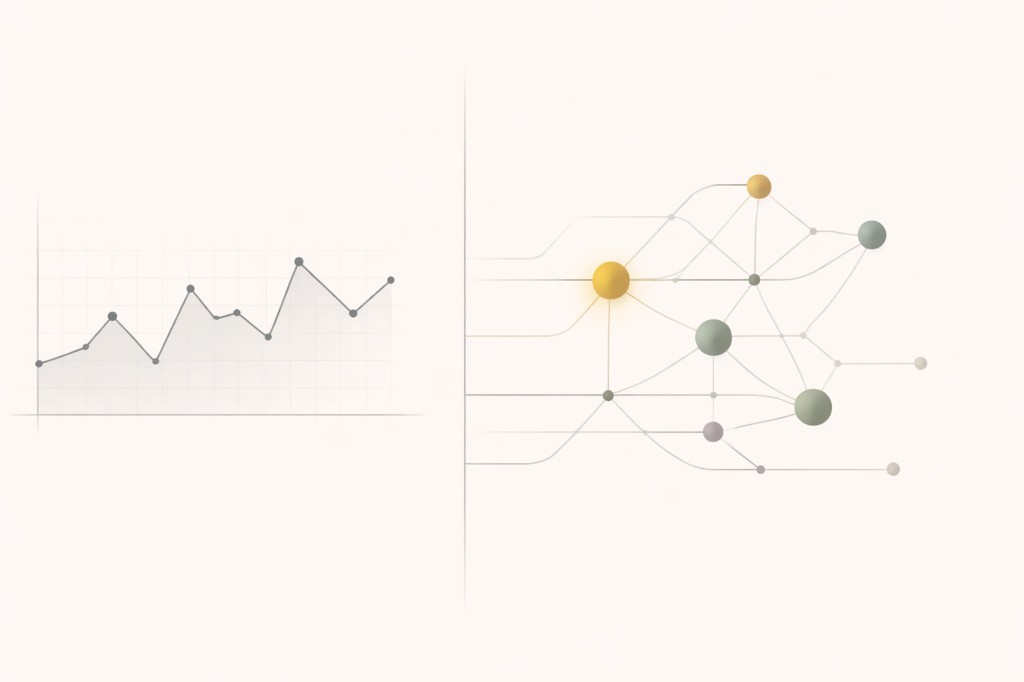
Tracking records what happened. Diagnosis tells you what is failing and why it matters now. Most personal tools are trackers: they log data and display charts. Free60 is a diagnostic: it reads signals across 3 dimensions, detects structural drift, and flags failure modes before they cascade into visible problems.
What does tracking actually do?
Tracking is passive observation with storage. You record a data point. The tool saves it. Over time, you accumulate a history. You can look at charts and see trends. The tool's job is to faithfully record what you gave it and present it back to you.
This is useful. Knowing that you slept 6.5 hours last night, walked 8,000 steps, or spent $340 on groceries this week is real information. The problem is not that this information is wrong. The problem is that it stops at observation.
A tracker does not tell you whether 6.5 hours of sleep represents stability or decline relative to your personal baseline. It does not tell you whether 8,000 steps is structurally sufficient given your current training load. It does not tell you whether $340 on groceries is a signal of expense drift when combined with your other spending categories over the past 90 days.
Tracking answers: what happened? It does not answer: what does this mean for the structural integrity of the system it belongs to?
What does diagnosing require that tracking does not?
Diagnosis requires three things that no tracker provides: a failure model, baseline-relative scoring, and cross-system pattern detection.
A failure model defines what "failing" looks like for each measured system. Not a generic red/yellow/green based on population averages, but a defined set of conditions that constitute structural degradation for a specific metric. In Free60, every KPI has thresholds that determine when a lever is stable, when it is drifting, and when it is approaching a failure boundary. The 5-gate framework requires every KPI to represent an independent failure mode before it enters the system.
Baseline-relative scoring measures you against yourself, not against averages. A tracker might show that you slept 7 hours. A diagnostic compares that 7 hours against your personal 30-day rolling baseline, factors in your consistency variance, and scores the deviation. Seven hours might be excellent for you or it might represent a 12% decline from your stable baseline. Without the baseline, the number has no diagnostic value.
Cross-system pattern detection reads signals across dimensions simultaneously. When sleep consistency degrades in Health, focus block integrity slips in Capacity, and schedule allocation drifts away from stated priorities, a tracker shows three separate declining charts in three separate apps. A diagnostic reads a single cascade with a traceable origin point. The pattern is the signal. Isolated data points are noise.
Why do most tools stop at tracking?
Building a tracker is straightforward. Accept input, store it, display it. Building a diagnostic requires defining what structural failure looks like across every measured domain, creating scoring logic that adapts to individual baselines, and implementing detection algorithms that surface cross-system patterns.
Most tools stop at tracking because diagnosis is a fundamentally harder problem that requires a comprehensive model of what you are diagnosing. A step counter does not need a theory of physical structural stability. A budget app does not need a model of financial resilience. They record numbers. The interpretation is left to you.
Free60 was built on the premise that the interpretation is the valuable part. The data itself is increasingly available from Apple Health (iOS) or Health Connect (Android), bank feeds, and calendar APIs. What is missing is the framework that turns data into a structural read: is this system stable, is it drifting, and if it is drifting, what is the failure mode and how does it connect to other systems?
What does structural drift look like in practice?
Structural drift is the gradual degradation of a life system that occurs below the threshold of conscious detection. Each individual data point looks acceptable. The trendline is moving toward a failure boundary.
A tracker cannot detect drift by design. It shows you today's number. You look at it, it seems fine, you move on. The 2% monthly increase in your expense base is invisible in any single observation. The slow compression of your sleep consistency window is undetectable night by night. The progressive narrowing of your income sources is a non-event on any given pay period.
Drift only becomes visible in a tracker when it has already cascaded into a noticeable problem. By then, the structural degradation is advanced. The early signal window has passed.
A diagnostic system detects drift by measuring deviation from baselines over defined time windows. Free60 compares current KPI values against rolling personal baselines and flags when the direction of change crosses a threshold, not when the absolute value crosses a boundary. This is the difference between detecting that your sleep consistency variance has increased 15% over 6 weeks versus noticing that you slept badly last night. The first is a structural signal. The second is a data point.
How does Free60 implement diagnosis instead of tracking?
Free60 measures 26 KPIs across 3 dimensions: Health, Wealth, and Capacity. Health and Wealth each contain 5 levers; Capacity contains 5 levers and 7 KPIs. Each lever contains KPIs designed to detect specific failure modes.
The system is not collecting data for display. It is collecting data for structural assessment. Every KPI is scored against personal baselines. Scores feed into lever assessments. Lever assessments feed into dimension scores. Dimension scores aggregate into the Freedom Index: a single number from 0 to 360 that represents your current structural stability.
When a KPI degrades, the system does not simply show you a lower number. It identifies the specific lever affected, the dimension it belongs to, and the relationship to other levers in the same or adjacent dimensions. If your Sleep consistency drops and your Focus or Schedule levers follow, the system reads the connection, not as two separate problems but as one structural cascade.
This is what a life diagnostic does that a tracker cannot. It reads the structural relationships between systems and surfaces the patterns that fragmented tracking distributes across isolated apps, making them invisible.
Why does this distinction matter for you?
If you are someone who already tracks things, you know the limits. You have the data. You can see the numbers. But you cannot see the structure. You cannot see which systems are stable and which are drifting. You cannot see how a change in one domain is propagating into another. You cannot see the early signals that precede the problems you will notice three months from now.
The distinction between tracking and diagnosing is the distinction between having data and having a structural read. Data tells you what happened. A structural read tells you what is happening to the system that data belongs to, whether the system is stable or failing, and where the failure is originating.
Most people have more than enough data. What they lack, and what no habit tracker or single-domain app provides, is the diagnostic framework that turns that data into something you can actually act on before the problems become obvious.
Common questions
Can't I just track things in a spreadsheet?
You can track anything in a spreadsheet. But tracking is not diagnosing. A spreadsheet records data. It does not apply a failure model, detect cross-dimensional drift, or flag cascading degradation. You would need to build baseline logic, threshold scoring, aggregation rules, and cross-system pattern detection manually. Free60 has this diagnostic framework built in, with 26 KPIs across 3 dimensions, each scored against personal baselines.
What does "structural drift" mean?
Structural drift is the gradual degradation of a life system that occurs below the threshold of conscious detection. Individual data points still look acceptable, but the trendline is moving toward a failure boundary. Examples: sleep duration holds steady but consistency variance increases 15% over three months. Income is stable but 90% now comes from a single source. Expenses are within budget but discretionary spending is compressing savings rate by 1% per month. Each reading looks fine. The direction does not.
FREE60 is available now on the App Store. 14-day free trial included.
Download on the App Store