Free60 vs Coaching Apps
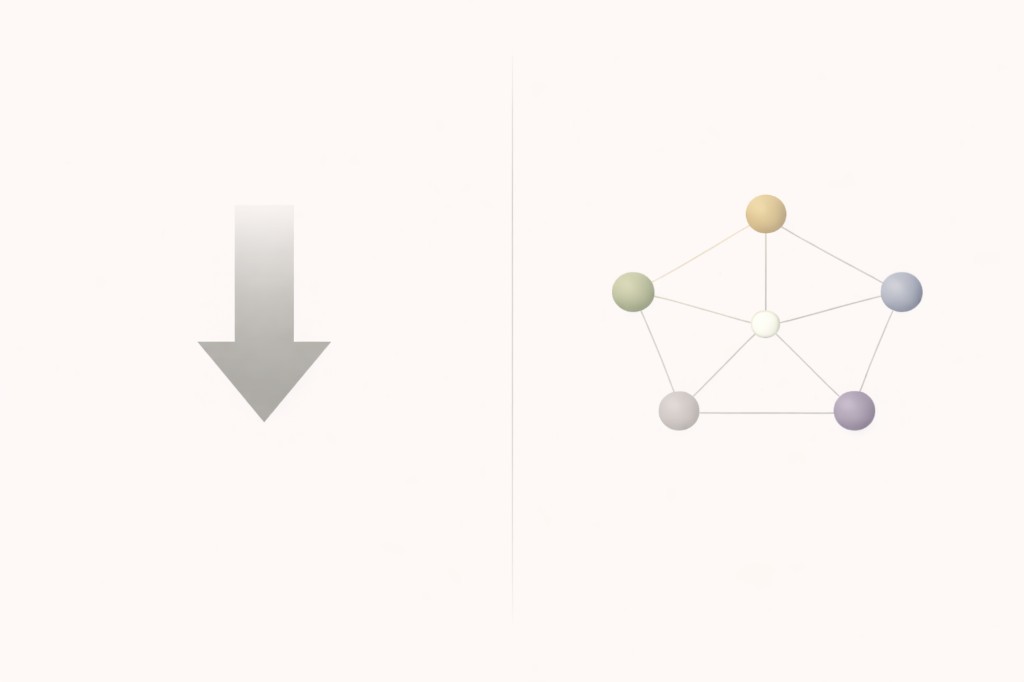
Coaching apps like BetterUp, Noom Coach, and various AI coaching tools prescribe actions: do this, change that, try this technique. They assume you need someone managing your behavior. Free60 assumes you are competent and need structural clarity. It detects instability across 3 dimensions and 26 KPIs, explains the mechanism, and surfaces data-driven actions. The final decision is always yours.
What do coaching apps assume about you?
Coaching apps assume a guidance gap. The user has a goal but does not know the best path to reach it, or knows the path but needs external structure and accountability to follow it. The app fills that gap by prescribing specific actions: "This week, try reducing your screen time by 20 minutes." "Set a goal to walk 8,000 steps." "Schedule a reflection session on Friday." The prescriptions come from behavioral frameworks, and the app monitors compliance.
This model works when the user genuinely lacks domain knowledge or needs external structure. Someone new to nutrition benefits from meal guidance. Someone starting an exercise routine benefits from progressive programming. The coaching model serves people who need to be told what to do.
The model fails when applied to people who already know what to do. And that is exactly who Free60 is built for.
What does Free60 assume about you instead?
Free60 assumes competence. Its target user is an analytical, self-directed professional, typically 35 to 50, in a senior role. This person does not need someone to tell them to exercise, save money, or sleep more. They already know. Their problem is not knowledge or motivation. Their problem is visibility.
They cannot see across all the systems in their life simultaneously. They cannot detect that their sleep architecture is degrading while their financial reserves are shrinking while their time allocation is shifting toward reactive work. No single coaching app sees all of that. No coach sees all of that in real time. Free60 does, because it measures 26 KPIs across Health, Wealth, and Capacity continuously.
The system diagnoses, educates, and guides. It does not motivate, gamify, or prescribe routines. That distinction defines the product. For more on what a life diagnostic actually does, and how it differs from coaching-driven tools, the framework is documented there.
How does prescriptive differ from diagnostic?
A prescriptive tool tells you what to change. "Your sleep is poor. Try going to bed 30 minutes earlier." "Your stress is high. Here is a breathing exercise." The tool diagnoses the problem and provides the solution in one step. The user's role is to comply.
A diagnostic tool tells you what is failing. "Your Sleep Consistency KPI has dropped 18% over the past 3 weeks. Your sleep timing standard deviation increased from 32 minutes to 54 minutes." But Free60 goes further: automated insight cards explain the mechanism (why consistency matters more than duration), show cascading effects (how sleep inconsistency disrupts autonomic balance), and surface specific actions (keep bedtime variation within 30 minutes). It guides without managing your behavior. No motivational pressure. No streaks. Just data-driven clarity.
Why stop at detection? Because the correct response depends on context that no app can fully see. Maybe your sleep timing drifted because of a work project that ends next week. Maybe it drifted because of a structural change in your household schedule that requires a different kind of response. The person with the context is you, not the app. Prescribing generic solutions to structural problems produces noise, not clarity.
What happens when coaching is personality-dependent?
Coaching effectiveness depends on fit. A coach's style, communication approach, and framework need to match the user's personality and preferences. BetterUp addresses this by matching users with coaches. AI coaching apps try to calibrate their tone based on user responses. But the fundamental limitation remains: the coaching model works best when the user is receptive to being coached.
Many analytical professionals are not. They find prescriptive advice patronizing when they already understand the domain. They find motivational language grating. They find action prompts intrusive. They want data and structure, not encouragement and guidance.
Free60 removes personality from the equation entirely. The system is structural, not relational. It measures the same 26 KPIs, applies the same scoring thresholds, and produces the same diagnostic output regardless of whether the user finds motivational language appealing or repulsive. The 4 AI guides (Halo, Luma, Auri, Nexo) explain data patterns in diagnostic language. They surface connections. They flag risk. They do not coach.
What is the difference between "what to do" and "what is failing"?
This is the sharpest dividing line. A coaching app answers "what should I do?" Free60 answers "what is failing?"
"What should I do?" presumes the user needs direction. The answer is always an action: start this, stop that, try this differently. It is forward-looking and prescriptive. It requires the app to have an opinion about the right course of action.
"What is failing?" presumes the user needs visibility. The answer is always a state: this KPI is degrading, this dimension has a structural gap, this pattern suggests a cascade is forming. It is present-looking and diagnostic. It requires the app to have a rigorous measurement framework, which Free60 provides through 26 KPIs, 15 levers, and the Freedom Index.
But visibility alone is not enough. Free60 also explains why each failure matters and surfaces specific, data-driven actions through automated insight cards. The self-directed professional does not need a coach telling them to "be more consistent." They need to see what is happening, understand the mechanism, and know where to focus. That is how the system works: diagnose, educate, guide -- and leave the final decision to the person with the context.
What do the AI guides do if they do not coach?
Free60 includes AI guides that understand the Free60 scoring system and can interpret your data. They serve a specific function: interpretation. When your Strain Trend or Autonomic Balance KPIs move, the guide explains what those metrics measure, what the score means in context, how they connect to adjacent KPIs (for example Sleep Quality and Activity Sufficiency), and what structural risk the pattern suggests.
The guide does not say "you should reduce your exercise intensity." It says "your Strain Trend relative to Autonomic Balance indicates that training load is outpacing recovery capacity. This pattern, combined with your Sleep Consistency trend, suggests a recovery gap." The interpretation stops at the boundary of your data. The action stays with you.
This is interpretation, not prescription. It is the difference between a radiologist reading an MRI (here is what we see, here is what it likely means) and a personal trainer prescribing a workout plan (here is what you should do). Free60 is the radiologist. You are the decision-maker.
Why does this distinction matter for analytical professionals?
Because analytical professionals are already drowning in advice. Every app, article, podcast, and newsletter tells them what to do. Sleep more. Exercise consistently. Invest early. Meditate. Set boundaries. Reduce screen time. The prescriptions are endless, generic, and usually redundant with what they already know.
What they lack is structural visibility. They cannot see which of these areas is actually degrading. They cannot see how degradation in one area is cascading into another. They cannot see whether their overall system is stable or quietly approaching a failure state. That is the gap Free60 fills: not more advice, but a clear, continuous, multi-dimensional diagnosis of what is actually happening.
When you can see clearly, understand the mechanism, and know where to focus, you do not need a coach.
Common questions
Does Free60 give advice?
Free60 does not motivate, gamify, or prescribe routines. But it does more than diagnose. Automated insight cards flag what's degrading, explain the mechanism behind it, and give specific data-driven actions. The 4 AI guides go deeper: they interpret your patterns and surface connections across dimensions. The decision is always yours -- but you're never left staring at a number with no context.
What do the AI guides actually do?
Free60 has 4 AI guides (Halo, Luma, Auri, Nexo) that understand the scoring system and can interpret your data. They explain what patterns mean, surface connections across dimensions, flag structural risk, and suggest what to investigate next. They do not coach or motivate. They provide diagnostic clarity and actionable direction.
FREE60 is available now on the App Store. 14-day free trial included.
Download on the App Store